
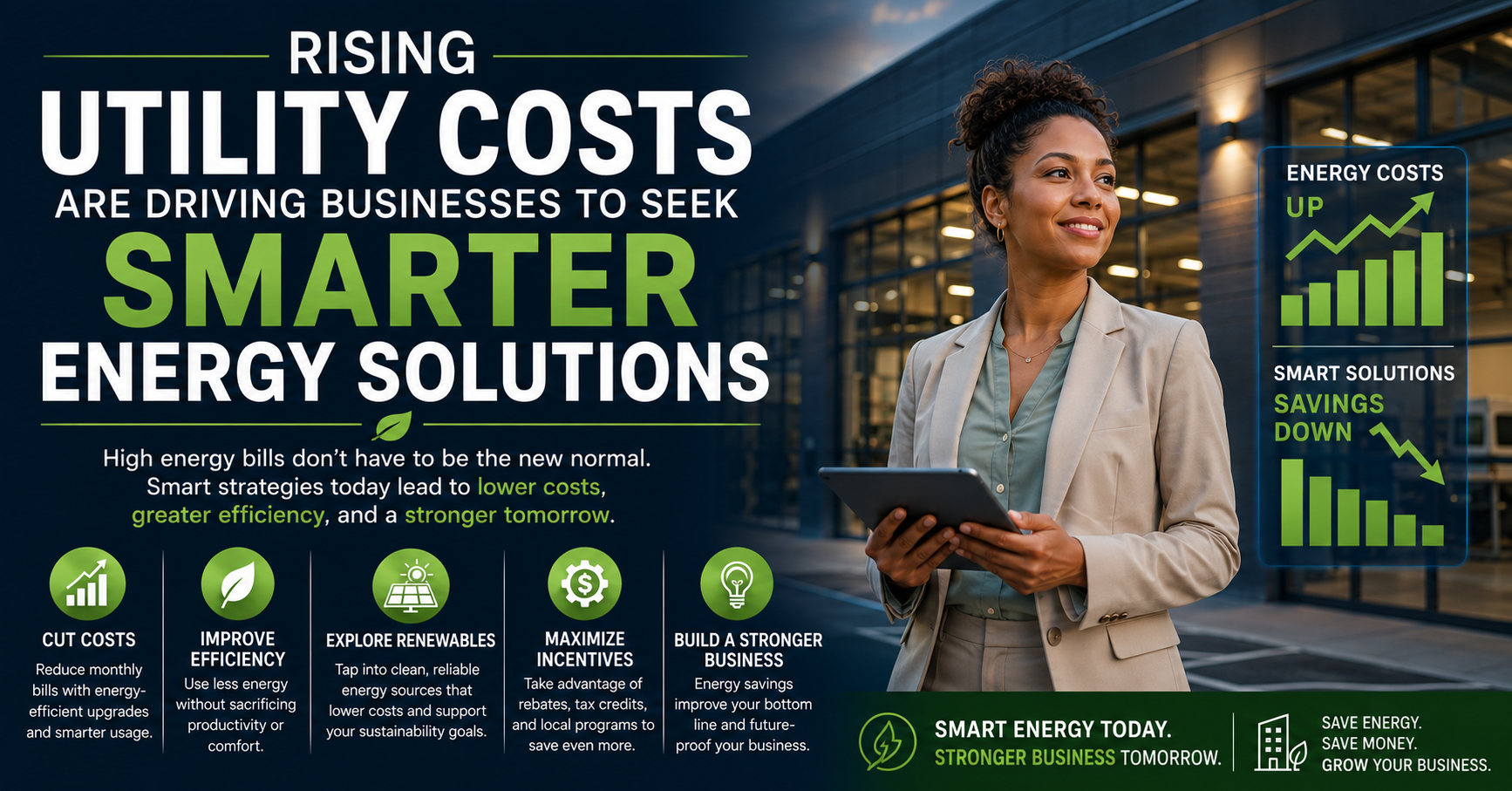
Rising Utility Costs Are Pushing Businesses to Explore Energy Savings
Lowering Expenses Through Smarter Energy Management
For businesses across nearly every industry, controlling operating expenses has become an increasingly important priority. Rising costs associated with labor, inventory, insurance, rent, transportation, and supplies continue to place pressure on profit margins. Among these expenses, utility costs often represent one of the largest and most unpredictable budget items.
Electricity, heating, cooling, refrigeration, lighting, manufacturing equipment, and other operational energy demands can significantly impact monthly expenses. For businesses operating large facilities, multiple locations, warehouses, retail stores, restaurants, medical offices, or manufacturing operations, utility bills can quickly become a major financial burden.
As energy prices continue to fluctuate and utility rates rise in many regions, businesses are increasingly seeking smarter ways to manage consumption and reduce costs. Through improved efficiency, modern technologies, and strategic energy planning, many organizations are discovering opportunities to lower expenses while improving long-term sustainability.
In today’s competitive business environment, smarter energy management is becoming more than a cost-saving strategy—it is becoming a critical component of financial success.
Rising Utility Costs Are Affecting Businesses Nationwide
Energy costs have become a growing concern for organizations of all sizes.
Whether operating a small office, a retail storefront, or a large industrial facility, businesses depend on reliable energy to support daily operations. Unfortunately, utility rates continue to experience volatility due to changing energy markets, infrastructure investments, environmental regulations, and increased demand.
For many businesses, rising utility costs reduce profitability without generating any additional value for customers.
Unlike investments in marketing, employee training, or product development, higher utility bills rarely contribute directly to business growth.
As a result, business owners are increasingly focused on identifying ways to reduce energy consumption without sacrificing operational efficiency.
Understanding Where Energy Is Being Used
One of the first steps toward reducing utility expenses is understanding how energy is being consumed.
Many businesses are surprised to learn that significant amounts of energy are often wasted through inefficient systems, outdated equipment, or unnecessary usage patterns.
Common sources of energy waste include:
- Aging HVAC systems
- Inefficient lighting
- Poor insulation
- Equipment left running after hours
- Inefficient refrigeration systems
- Outdated electrical equipment
- Improper thermostat settings
- Air leaks and ventilation issues
Without proper analysis, these inefficiencies can remain hidden for years while steadily increasing operating expenses.
Identifying these areas is often the foundation of a successful energy management strategy.
Energy Audits Reveal Hidden Opportunities
Many organizations begin their energy-saving efforts by conducting professional energy audits.
An energy audit provides a comprehensive assessment of how a facility consumes energy and identifies opportunities for improvement.
During an audit, specialists evaluate equipment performance, building efficiency, lighting systems, heating and cooling operations, insulation, and overall energy usage patterns.
The findings often reveal inefficiencies that business owners may not have previously recognized.
In many cases, relatively small adjustments can produce meaningful savings.
Examples may include:
- Replacing outdated lighting
- Adjusting operating schedules
- Upgrading thermostats
- Improving insulation
- Repairing air leaks
- Optimizing equipment settings
These improvements frequently generate measurable reductions in utility expenses with relatively modest investments.
Energy-Efficient Lighting Delivers Quick Results
Lighting is one of the most common opportunities for cost reduction.
Many businesses still operate older lighting systems that consume substantially more electricity than modern alternatives.
LED lighting technology has become increasingly popular because it provides significant energy savings while improving illumination quality and reducing maintenance requirements.
Compared to traditional incandescent or fluorescent lighting, LED systems consume less energy and often last much longer.
For businesses operating large facilities, retail spaces, warehouses, or office environments, lighting upgrades can generate noticeable reductions in monthly utility costs.
Many organizations experience a relatively quick return on investment after making the transition.
Smarter HVAC Systems Improve Efficiency
Heating and cooling systems often account for a significant portion of commercial energy consumption.
Outdated HVAC equipment can operate inefficiently, leading to excessive energy use and higher utility bills.
Modern HVAC systems offer substantial improvements in efficiency while providing greater control over indoor environments.
Smart thermostats, automated temperature controls, zoning systems, and energy management software allow businesses to optimize heating and cooling schedules based on occupancy and operational needs.
These technologies help reduce unnecessary energy consumption while maintaining comfort for employees and customers.
Proper maintenance also plays an important role in maximizing HVAC efficiency.
Regular inspections, filter replacements, and equipment servicing can improve performance while extending system lifespan.
Automation Is Transforming Energy Management
Advancements in technology are making energy management more sophisticated and effective than ever before.
Automated energy management systems allow businesses to monitor and control energy usage in real time.
These systems can:
- Track energy consumption
- Identify inefficiencies
- Automatically adjust settings
- Monitor equipment performance
- Generate energy reports
- Detect unusual usage patterns
By leveraging automation, businesses can make more informed decisions and respond quickly to changing energy demands.
Many organizations use these technologies to create ongoing energy optimization strategies rather than relying solely on periodic evaluations.
Solar Energy Is Becoming Increasingly Attractive
Solar energy has emerged as one of the most popular long-term solutions for businesses seeking greater control over utility expenses.
Advancements in solar technology, financing options, and installation methods have made renewable energy more accessible than ever before.
Many businesses are exploring solar solutions to:
- Reduce monthly utility bills
- Stabilize long-term energy costs
- Protect against future rate increases
- Improve sustainability initiatives
- Strengthen environmental responsibility efforts
Depending on location, facility characteristics, and energy usage patterns, solar systems may generate substantial savings over time.
For some businesses, solar energy represents an opportunity to transform a recurring operating expense into a long-term financial asset.
Sustainability Is Becoming a Competitive Advantage
Reducing energy consumption offers benefits beyond cost savings.
Today’s consumers increasingly value environmental responsibility and sustainable business practices.
Many customers prefer supporting companies that actively work to reduce their environmental impact.
Businesses that implement energy-efficient technologies and renewable energy solutions often strengthen their brand reputation while demonstrating commitment to responsible resource management.
These efforts can improve customer perception, support corporate social responsibility initiatives, and create additional competitive advantages.
As environmental awareness continues growing, sustainability is becoming an increasingly important component of business strategy.
Energy Management Supports Long-Term Growth
Ultimately, smarter energy management is about more than reducing monthly utility bills.
Lower energy costs improve cash flow, increase profitability, and create additional resources that can be reinvested into business growth.
Funds saved through energy efficiency can support:
- Hiring additional employees
- Expanding operations
- Investing in marketing
- Upgrading technology
- Improving customer experiences
- Developing new products and services
By reducing waste and optimizing energy usage, businesses strengthen their financial position while preparing for future growth opportunities.
A Strategic Approach to Controlling Costs
As utility rates continue to rise and economic pressures increase, businesses can no longer afford to overlook energy management.
Organizations that proactively evaluate energy consumption, implement efficiency improvements, leverage modern technologies, and explore renewable energy solutions often position themselves for stronger long-term performance.
Whether through energy audits, lighting upgrades, HVAC improvements, automation systems, or solar energy investments, smarter energy management offers meaningful opportunities to reduce expenses and improve profitability.
In an environment where every dollar matters, controlling utility costs may be one of the most practical and impactful strategies available to business owners. By lowering expenses through smarter energy management, businesses can create stronger financial foundations while supporting sustainability goals that benefit both their organizations and the communities they serve.