
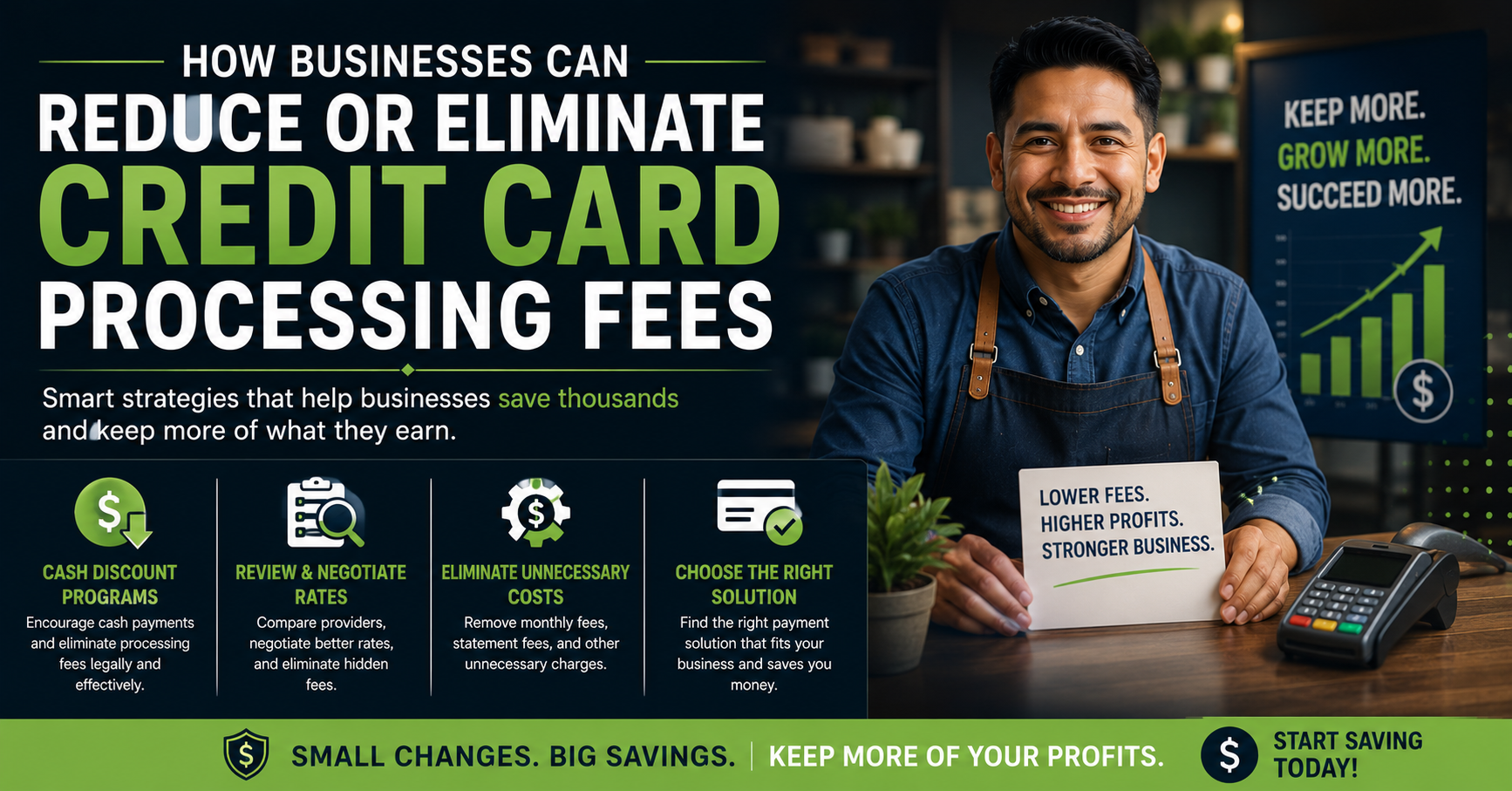
How Businesses Can Reduce or Eliminate Credit Card Processing Fees
Keeping More Revenue Instead of Giving It Away
For many businesses, credit card processing fees quietly consume thousands—or even tens of thousands—of dollars each year. While business owners often focus on controlling expenses such as payroll, rent, inventory, insurance, and marketing, payment processing costs frequently go unnoticed despite having a direct impact on profitability.
Because these fees are deducted automatically from transactions, many businesses simply accept them as a normal cost of doing business. However, as profit margins continue to tighten across many industries, business owners are taking a closer look at their payment processing expenses and discovering opportunities to significantly reduce or even eliminate many of these costs.
In today’s competitive business environment, keeping more of the revenue already being generated can sometimes be just as valuable as increasing sales.
The Hidden Cost of Accepting Credit Cards
Most consumers prefer the convenience of paying with credit cards, debit cards, mobile wallets, and other electronic payment methods. As a result, businesses often have little choice but to accept card payments in order to remain competitive.
However, every card transaction involves multiple parties, including issuing banks, payment processors, merchant service providers, and card networks such as Visa, Mastercard, Discover, and American Express.
Each participant receives a portion of the processing fee.
For many businesses, these fees range between 2% and 4% of every transaction, depending on the payment method, processor, card type, and transaction structure.
At first glance, a few percentage points may not seem significant. However, the impact becomes substantial as transaction volume increases.
For example:
- A business processing $250,000 annually may pay $5,000 to $10,000 in fees.
- A business processing $500,000 annually may pay $10,000 to $20,000 in fees.
- A business processing $1 million annually may pay $20,000 to $40,000 or more.
Over several years, these expenses can represent a significant loss of revenue that could otherwise be reinvested into growth initiatives.
Why Profit Margins Matter
Many small businesses operate on relatively thin profit margins.
Restaurants, retail stores, contractors, service providers, salons, automotive businesses, and healthcare practices often face rising labor costs, increasing supply expenses, higher rent, and growing insurance premiums.
In these environments, every dollar matters.
Unlike increasing sales—which often requires additional marketing expenses, staffing, inventory, and operational investments—reducing payment processing costs can immediately improve profitability without requiring any increase in business volume.
Simply put, money saved is money earned.
Understanding Cash Discount Programs
One of the most popular solutions businesses are exploring today is cash discounting.
Under a properly structured cash discount program, businesses establish standard pricing for card transactions while offering customers a discount when they choose to pay with cash.
This approach allows businesses to offset many or all of their payment processing expenses while still providing customers with payment options.
Many consumers appreciate the opportunity to save money by paying with cash, while businesses benefit from reduced transaction costs.
When implemented correctly and in compliance with applicable regulations, cash discount programs can provide substantial financial benefits.
Business owners considering this option should work with qualified payment professionals to ensure proper disclosure and compliance requirements are met.
Surcharging Is Another Option
Another increasingly common strategy involves surcharging.
Under a surcharge model, businesses pass a portion of the credit card processing fee directly to customers who choose to pay with credit cards.
This approach allows businesses to recover some or all of their processing expenses while maintaining profitability.
However, surcharge programs are subject to various state laws, card network regulations, disclosure requirements, and compliance standards.
Because regulations vary by location and payment type, businesses should carefully evaluate the legal and operational requirements before implementing a surcharge program.
When structured appropriately, surcharging can significantly reduce processing costs without negatively impacting customer satisfaction.
Negotiating Better Rates
Many business owners are surprised to learn that payment processing rates are not always fixed.
Businesses often remain with the same merchant services provider for years without reviewing their pricing structure.
Over time, fees may increase, new charges may be added, or more competitive options may become available.
Regularly reviewing merchant statements can help identify opportunities to negotiate lower rates or eliminate unnecessary fees.
Business owners should pay close attention to:
- Monthly service fees
- Statement fees
- Equipment fees
- PCI compliance charges
- Batch fees
- Gateway fees
- Non-qualified transaction fees
Even small reductions across multiple fee categories can produce meaningful annual savings.
Evaluating New Payment Technologies
The payment processing industry continues evolving rapidly.
New technologies, payment platforms, and merchant service solutions are creating additional opportunities for businesses to lower costs and improve efficiency.
Many modern systems offer:
- Lower transaction rates
- Integrated point-of-sale systems
- Mobile payment acceptance
- Automated reporting
- Contactless payments
- Enhanced security features
- Improved customer experiences
Business owners who periodically evaluate emerging payment technologies often discover solutions that better align with their operational needs and financial goals.
Staying informed about industry developments can help businesses remain competitive while reducing unnecessary expenses.
Customer Experience Still Matters
While reducing processing fees is important, customer experience should remain a top priority.
Consumers increasingly expect convenient payment options and seamless checkout experiences.
Businesses must balance cost-saving initiatives with customer satisfaction to avoid creating friction during transactions.
The most successful payment strategies typically provide flexibility, transparency, and convenience while helping businesses control expenses.
When customers clearly understand available payment options and any associated pricing structures, they are generally more receptive to alternative payment programs.
Small Savings Create Big Results
One of the most overlooked aspects of payment optimization is the cumulative impact of small savings.
A business that saves $500 per month on processing fees retains an additional $6,000 annually.
Over five years, that equates to $30,000 in retained revenue.
For larger businesses, the savings can be even more significant.
These funds can be redirected toward marketing, hiring employees, upgrading equipment, expanding operations, or increasing profitability.
Because payment processing expenses occur with nearly every transaction, even modest improvements can create substantial long-term financial benefits.
A Smarter Approach to Profitability
As operating costs continue rising across many industries, business owners are searching for practical ways to protect their margins and strengthen financial performance.
Reviewing payment processing systems is often one of the fastest and most effective opportunities available.
Whether through cash discount programs, surcharging strategies, rate negotiations, technology upgrades, or fee optimization, businesses may be able to recover revenue that has been quietly disappearing for years.
For companies operating in competitive markets, reducing processing expenses can have a direct and measurable impact on profitability without requiring additional customers, additional employees, or additional sales.
The businesses that regularly evaluate their payment systems often discover valuable opportunities to keep more of the money they have already worked hard to earn. In an economy where every dollar counts, retaining revenue instead of giving it away may be one of the smartest business decisions an owner can make.