• All
  • Blog
  • Business Growth
  • Digital Marketing
  • Energy
  • Marketing
  • Opportinity
  • Opportunities
  • Savings
  • Technology
  • Uncategorized

Why Small Businesses Are Becoming the Backbone of Local Economies


Community Growth Starts With Entrepreneurs

Across cities and towns throughout America, small businesses continue to serve as the foundation of local economic growth and community development. While large corporations often dominate national headlines, it is entrepreneurs and small business owners who frequently create the unique character, economic vitality, and opportunities that help communities thrive.

From family-owned restaurants and neighborhood retail stores to construction companies, healthcare providers, technology startups, and professional service firms, entrepreneurs play a vital role in strengthening local economies. Their contributions extend far beyond simply selling products or services. They create jobs, support local organizations, invest in community initiatives, and help generate the economic activity that keeps communities growing.

As economic conditions continue to evolve, many experts believe that the long-term success of local communities will increasingly depend on the ability of entrepreneurs to innovate, adapt, and build sustainable businesses that serve local needs.

Small Businesses Are Powerful Economic Engines

Entrepreneurs contribute significantly to economic development because they create opportunities where none previously existed.

Every new business begins with an idea. Whether it’s solving a problem, meeting a consumer need, or improving an existing service, entrepreneurs identify opportunities and transform them into businesses that generate revenue and employment.

When a business opens its doors, it often hires local employees, purchases supplies from nearby vendors, leases commercial space, and pays local taxes. These activities create a ripple effect throughout the community.

For example, a new restaurant may hire cooks, servers, managers, and cleaning staff. It may purchase ingredients from local suppliers, use local contractors for maintenance, and partner with nearby businesses for marketing efforts. The wages earned by employees are then spent throughout the community, supporting additional businesses and services.

This cycle of economic activity helps create stronger and more resilient local economies.

Job Creation Begins With Entrepreneurs

One of the most important contributions entrepreneurs make is job creation.

Small businesses collectively employ millions of workers across the United States and often provide employment opportunities that larger organizations may overlook.

Entrepreneurs frequently hire individuals from within their communities, creating jobs for local residents and helping families achieve greater financial stability.

In many towns and cities, small businesses represent one of the largest sources of employment. They offer positions across a wide variety of industries, including retail, hospitality, healthcare, construction, professional services, education, and technology.

As businesses grow, they often create additional opportunities for advancement, training, and career development.

This ability to generate employment not only benefits individual workers but also strengthens the broader economic health of entire communities.

Local Businesses Keep Money in Local Communities

Economic studies consistently show that locally owned businesses often reinvest a greater percentage of their revenue back into their communities compared to national chains or large corporations.

When consumers spend money at local businesses, more of those dollars tend to remain within the local economy.

Business owners frequently purchase goods and services from nearby suppliers, hire local contractors, support community organizations, and contribute to local charitable causes. This circulation of money helps create additional economic activity and strengthens the overall financial health of the region.

Many entrepreneurs also sponsor youth sports teams, community events, nonprofit organizations, and educational programs that directly benefit local residents.

Their investments help improve the quality of life within their communities while fostering stronger relationships among residents and businesses.

Innovation Often Starts Small

Entrepreneurs are frequently responsible for some of the most innovative ideas and solutions in the marketplace.

Unlike larger organizations that may face complex approval processes and bureaucratic structures, small businesses can often adapt quickly to changing customer needs and market conditions.

This flexibility allows entrepreneurs to experiment with new products, services, technologies, and business models.

Many successful companies that operate globally today began as small entrepreneurial ventures founded by individuals who recognized opportunities that others overlooked.

Innovation is not limited to technology startups. Entrepreneurs across every industry continue finding creative ways to improve customer experiences, streamline operations, and solve everyday challenges.

Their willingness to take risks and pursue new ideas helps drive economic progress and industry advancement.

Technology Is Expanding Opportunities

Modern technology has dramatically increased the ability of entrepreneurs to compete with larger organizations.

Digital marketing, social media, e-commerce platforms, cloud-based software, and artificial intelligence tools allow small businesses to reach customers far beyond their local markets.

A business owner operating from a small town can now sell products nationwide, offer virtual services globally, or build an online audience that generates revenue from multiple sources.

Technology has reduced many of the barriers that once prevented entrepreneurs from competing on a larger scale.

At the same time, these tools enable businesses to maintain their local roots while expanding their reach and increasing profitability.

Consumers Value Personal Connections

Another reason small businesses remain important is the personalized experience they often provide.

Many consumers appreciate doing business with companies that know their names, understand their needs, and actively participate in the community.

Small business owners frequently build strong relationships with customers through exceptional service, local involvement, and direct communication.

These personal connections help create trust and loyalty that can be difficult for larger organizations to replicate.

As consumers increasingly seek authentic experiences and meaningful relationships with brands, local businesses continue to enjoy unique advantages.

The Future of Local Economies

Looking ahead, entrepreneurs will likely play an even greater role in shaping the future of local communities.

Economic growth, job creation, innovation, and community development are all closely tied to the success of small businesses.

Communities that encourage entrepreneurship through education, mentorship, access to capital, and supportive business environments often position themselves for stronger long-term growth.

Entrepreneurs bring energy, creativity, and determination to the marketplace. They identify opportunities, solve problems, and create value for customers while strengthening the communities they call home.

The continued success of entrepreneurs may ultimately determine the strength, resilience, and prosperity of many local economies for generations to come. As communities evolve and new challenges emerge, one thing remains clear: community growth starts with entrepreneurs.



How Technology Is Fueling the Next Generation of Entrepreneurs


Innovation Creates New Business Possibilities

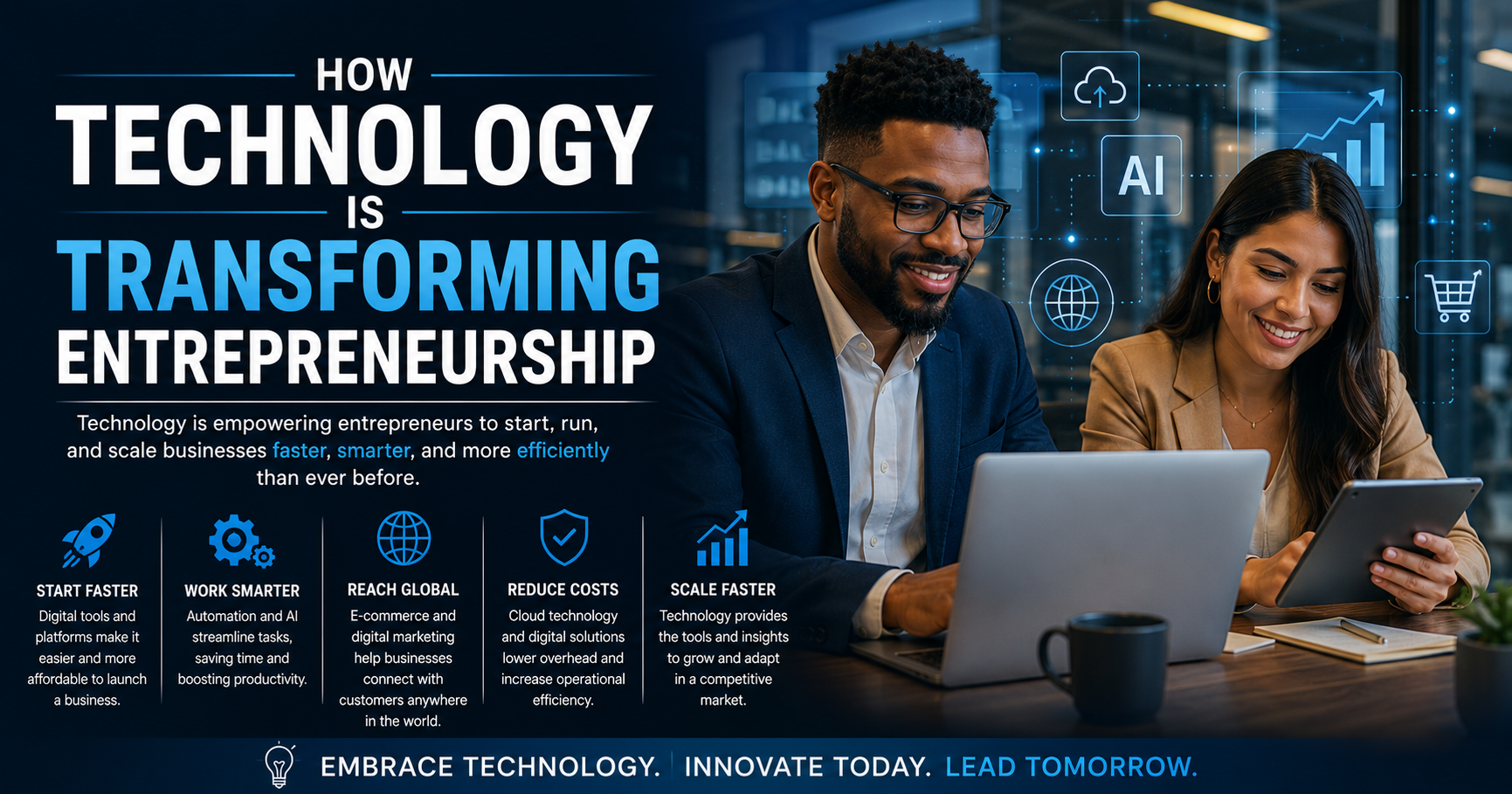
Technology continues to transform nearly every aspect of entrepreneurship, creating opportunities that were once unimaginable for small business owners and aspiring entrepreneurs. What previously required significant capital, large teams, expensive infrastructure, and years of development can now often be accomplished with affordable digital tools and cloud-based platforms.

The rapid advancement of technology is reshaping how businesses are started, operated, marketed, and scaled. Entrepreneurs today have access to resources that allow them to compete in ways that were once reserved for large corporations with substantial budgets and extensive personnel.

As innovation continues to accelerate, business owners who embrace technology are discovering new opportunities to increase efficiency, reduce costs, reach broader audiences, and build more resilient organizations.

In many ways, technology has become one of the greatest equalizers in modern business.

Technology Has Lowered the Barriers to Entry

Historically, launching a business often required significant upfront investment.

Entrepreneurs needed office space, specialized equipment, large marketing budgets, extensive staffing, and access to costly technology systems. These barriers made business ownership difficult for many aspiring entrepreneurs.

Today, technology has dramatically reduced many of those obstacles.

A business owner can launch a professional website, accept online payments, manage customer relationships, automate marketing campaigns, and operate remotely using affordable software solutions available through monthly subscriptions.

Cloud computing has been particularly transformative.

Rather than investing thousands of dollars in servers and technology infrastructure, businesses can access powerful computing resources on demand. This allows entrepreneurs to scale operations quickly while minimizing startup costs.

As a result, individuals with innovative ideas can bring products and services to market faster and more efficiently than ever before.

Artificial Intelligence Is Reshaping Entrepreneurship

Few technological developments have generated as much excitement as artificial intelligence.

AI is rapidly changing how entrepreneurs operate their businesses by helping automate repetitive tasks, improve decision-making, and increase productivity.

Business owners are increasingly using artificial intelligence to:

  • Create marketing content
  • Generate social media posts
  • Draft emails and newsletters
  • Analyze customer behavior
  • Conduct market research
  • Improve customer service
  • Optimize advertising campaigns
  • Streamline administrative tasks

These capabilities allow entrepreneurs to accomplish more in less time while reducing operational costs.

Tasks that once required multiple employees can often be completed using AI-powered tools, freeing entrepreneurs to focus on strategy, innovation, and growth.

As artificial intelligence continues evolving, experts believe its impact on entrepreneurship will only increase.

Businesses that learn to effectively integrate AI into their operations may gain significant competitive advantages in the years ahead.

Automation Creates Greater Efficiency

Automation is another powerful force transforming modern entrepreneurship.

Many routine business processes can now operate with minimal human intervention.

Automated systems can manage:

  • Appointment scheduling
  • Customer follow-up communications
  • Inventory tracking
  • Invoice generation
  • Lead nurturing
  • Marketing campaigns
  • Customer support requests
  • Data collection and reporting

By automating repetitive tasks, entrepreneurs can reduce labor costs, minimize human error, and improve operational consistency.

This efficiency allows business owners to focus their energy on activities that drive revenue and create value for customers.

For many entrepreneurs, automation has become a critical component of scalability.

Digital Marketing Expands Market Reach

Technology has also revolutionized how businesses connect with customers.

In the past, reaching large audiences often required expensive advertising through television, radio, newspapers, or direct mail campaigns.

Today, entrepreneurs can market products and services through digital channels that offer significantly greater targeting capabilities and measurable results.

Search engines, social media platforms, email marketing systems, video content, and online advertising networks allow businesses to reach specific audiences based on demographics, interests, behaviors, and purchasing patterns.

This precision enables entrepreneurs to maximize marketing budgets while generating higher-quality leads.

Even small businesses can now compete for attention in national and global markets.

Digital marketing has democratized customer acquisition and created opportunities for businesses of all sizes to grow.

E-Commerce Creates Global Opportunities

The growth of e-commerce has expanded business possibilities far beyond local markets.

Entrepreneurs no longer need multiple physical locations to reach customers across the country or around the world.

Online stores, digital marketplaces, and fulfillment services allow businesses to sell products globally while operating from a single location.

Consumers increasingly prefer the convenience of online shopping, creating new opportunities for entrepreneurs to launch product-based businesses with relatively low overhead.

The ability to reach larger audiences has enabled countless businesses to scale faster and generate revenue from customers who would have been inaccessible through traditional retail models.

E-commerce continues to open doors for entrepreneurs willing to embrace digital commerce strategies.

Data Is Driving Smarter Decisions

Modern technology provides entrepreneurs with access to unprecedented amounts of data.

Businesses can now monitor customer behavior, track marketing performance, evaluate sales trends, and analyze operational efficiency in real time.

This information helps entrepreneurs make more informed decisions and identify opportunities for improvement.

Rather than relying solely on intuition, business owners can leverage analytics to understand what is working and where adjustments may be needed.

Data-driven decision-making often leads to:

  • Improved customer experiences
  • More effective marketing campaigns
  • Higher conversion rates
  • Better resource allocation
  • Increased profitability

Access to actionable insights has become a significant advantage for businesses that understand how to use data effectively.

Innovation Is Creating Entirely New Industries

Technology is not only improving existing businesses—it is creating entirely new business models and industries.

The rise of artificial intelligence, renewable energy, digital education, software-as-a-service platforms, creator economies, remote work technologies, and online consulting services has generated opportunities that did not exist just a few years ago.

Entrepreneurs are finding innovative ways to solve problems, deliver services, and create value using technologies that continue to evolve at remarkable speed.

Those who stay informed about emerging trends often position themselves to capitalize on new opportunities before markets become saturated.

Innovation frequently rewards individuals who are willing to experiment, adapt, and embrace change.

The Human Element Still Matters

Despite the rapid advancement of technology, successful entrepreneurship remains rooted in human creativity, leadership, and problem-solving.

Technology serves as a powerful tool, but it cannot replace vision, strategic thinking, relationship-building, and customer understanding.

The most successful entrepreneurs are often those who combine technological capabilities with strong interpersonal skills and a deep understanding of customer needs.

Innovation works best when technology enhances human strengths rather than attempting to replace them.

This balance allows businesses to remain efficient while maintaining the personal connections that customers value.

The Future Belongs to Innovative Entrepreneurs

Experts predict that technology will continue transforming entrepreneurship for decades to come.

Artificial intelligence, automation, cloud computing, advanced analytics, and emerging digital platforms will likely create even more opportunities for innovation and growth.

Entrepreneurs who remain adaptable and open to change will be best positioned to benefit from these developments.

Innovation is no longer optional in today’s business environment. Companies that resist technological advancement risk falling behind competitors that embrace new tools and strategies.

For modern entrepreneurs, technology represents more than convenience—it represents opportunity.

Those who effectively combine human creativity with technological innovation may find themselves positioned to capitalize on some of the largest business opportunities of the next decade. In a rapidly evolving economy, embracing innovation may ultimately be the difference between merely surviving and truly thriving.


The Entrepreneurial Mindset That Separates Success From Failure


Thinking Like a Business Builder

While funding, products, services, and marketing strategies are all important components of business success, many successful entrepreneurs believe that mindset is often the true deciding factor between long-term success and failure. The way entrepreneurs think, respond to challenges, and approach opportunities frequently determines whether they can navigate the inevitable obstacles that come with building a business.

Entrepreneurship is rarely a straight path. Markets change, customer needs evolve, competitors emerge, and unexpected setbacks can appear without warning. While these realities can discourage some individuals, successful entrepreneurs often develop a different perspective. They learn to view challenges as opportunities to improve, innovate, and grow rather than as reasons to quit.

In today’s rapidly changing economy, developing a strong entrepreneurial mindset may be one of the most valuable investments a person can make.

Success Begins With Perspective

One of the defining characteristics of successful entrepreneurs is their ability to think differently about problems.

While many people see obstacles, entrepreneurs often see opportunities. They recognize unmet needs, identify inefficiencies, and search for ways to create value where others may see limitations.

This mindset allows entrepreneurs to remain optimistic even during difficult periods.

Economic downturns, changing consumer behaviors, and industry disruptions can create uncertainty. However, entrepreneurs who maintain a solution-oriented perspective are often better positioned to adapt and identify new opportunities.

Rather than asking, “Why is this happening?” they often ask, “How can I respond?” or “What opportunity exists within this challenge?”

This shift in thinking can make a significant difference in long-term outcomes.

Embracing Uncertainty

Entrepreneurship requires a willingness to operate in uncertain environments.

Unlike traditional employment, where responsibilities and compensation are often predictable, entrepreneurs regularly make decisions without having all the answers.

Launching a new product, entering a new market, hiring employees, or investing in growth initiatives all involve varying levels of risk.

Successful business builders understand that uncertainty is part of the entrepreneurial journey. Instead of waiting for perfect conditions, they gather information, evaluate potential outcomes, and take calculated action.

They recognize that progress often comes from making informed decisions rather than achieving absolute certainty.

This ability to move forward despite uncertainty frequently separates entrepreneurs from individuals who remain stuck in analysis and hesitation.

Failure Is Often Part of the Process

Many of the world’s most successful entrepreneurs have experienced significant failures before achieving success.

Products fail. Marketing campaigns underperform. Partnerships dissolve. Business models require adjustments.

The difference is that successful entrepreneurs rarely allow failure to define them.

Instead, they view setbacks as valuable learning experiences.

When a strategy does not produce the desired outcome, they analyze what happened, identify lessons learned, and apply those insights moving forward.

Every challenge becomes an opportunity to improve decision-making and strengthen the business.

This willingness to learn from mistakes helps entrepreneurs build resilience and develop greater confidence over time.

Discipline Creates Momentum

While motivation can be helpful, discipline is often what sustains long-term success.

Many entrepreneurs discover that building a business requires consistent effort over extended periods of time.

There are days when motivation is high and progress comes easily. There are also days when obstacles arise and results seem slow.

Successful business owners understand the importance of maintaining productive habits regardless of circumstances.

They establish routines, set goals, manage their time effectively, and focus on completing high-priority tasks.

Small, consistent actions performed over months and years often produce significant results.

Discipline helps entrepreneurs continue moving forward even when immediate rewards are not visible.

Adaptability Is a Competitive Advantage

Markets evolve constantly.

Consumer preferences change. New technologies emerge. Economic conditions fluctuate. Industries experience disruption.

Entrepreneurs who resist change often struggle to remain competitive.

By contrast, adaptable business owners view change as a normal part of growth.

They continuously evaluate market trends, gather customer feedback, and adjust strategies when necessary.

This flexibility enables them to remain relevant while identifying opportunities that competitors may overlook.

The ability to pivot when circumstances change has become increasingly important in today’s fast-moving business environment.

Adaptability is no longer simply an advantage—it is often a requirement for long-term success.

Lifelong Learning Fuels Growth

High-performing entrepreneurs are typically committed to continuous learning.

They understand that business ownership requires a broad range of skills, including leadership, communication, marketing, sales, finance, technology, and strategic planning.

Because industries evolve so quickly, entrepreneurs who stop learning often find themselves falling behind.

Successful business builders invest time in reading books, attending industry events, participating in training programs, networking with peers, and staying informed about emerging trends.

Many also seek mentors who can provide guidance based on real-world experience.

The willingness to learn and improve allows entrepreneurs to make better decisions and uncover new opportunities for growth.

Creating Value Beyond Profit

While profitability is essential for business sustainability, many successful entrepreneurs believe their primary mission is creating value.

Businesses exist because they solve problems.

Whether helping customers save time, improve health, increase productivity, reduce costs, or achieve personal goals, entrepreneurs succeed when they provide meaningful solutions.

This focus on value creation often leads to stronger customer relationships, greater loyalty, and long-term business success.

When entrepreneurs prioritize serving others, financial rewards frequently follow as a result of the value they provide.

This perspective helps business owners maintain focus on their customers rather than becoming solely driven by short-term profits.

Building Systems for Long-Term Success

Successful entrepreneurs also think beyond individual transactions.

Rather than constantly chasing the next sale, they focus on building systems that create sustainable growth.

These systems may include marketing processes, customer service frameworks, operational procedures, training programs, and technology solutions that improve efficiency and scalability.

By building systems rather than relying solely on personal effort, entrepreneurs create businesses that can continue growing over time.

This strategic thinking allows them to move from working in the business to working on the business.

The Entrepreneurial Mindset Matters More Than Ever

As technology continues to transform industries and economic conditions evolve, the importance of entrepreneurial thinking continues to grow.

Individuals who develop resilience, discipline, adaptability, and a commitment to lifelong learning are often better equipped to navigate uncertainty and capitalize on emerging opportunities.

Entrepreneurship is not simply about starting a business. It is about developing the mindset required to identify opportunities, solve problems, create value, and continue moving forward despite challenges.

In a world where change is constant, thinking like a business builder may be one of the most valuable skills anyone can develop.

Those who cultivate an entrepreneurial mindset position themselves not only to build successful businesses but also to create meaningful impact, generate opportunities for others, and contribute to stronger communities and economies. Ultimately, success begins with the way entrepreneurs think—and the actions they take because of it.


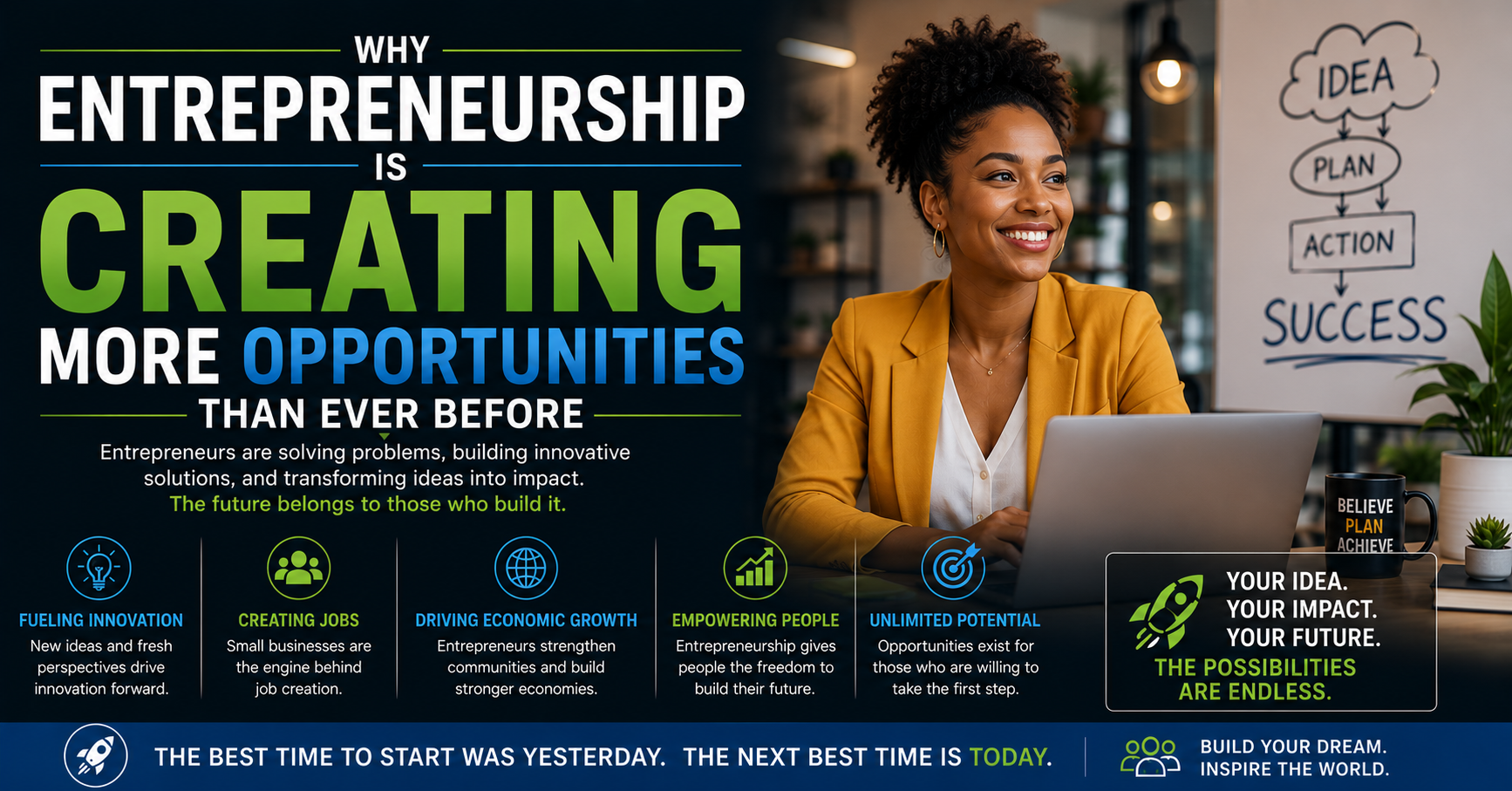
Why Entrepreneurship Is Creating More Opportunities Than Ever Before


The New Era of Business Ownership

For decades, starting a business required significant financial resources, access to investors, expensive office space, specialized equipment, and an extensive network of professional contacts. Entrepreneurship was often viewed as something reserved for individuals with substantial capital, industry connections, or years of business experience. While opportunities certainly existed, the barriers to entry were much higher than they are today.

The modern business landscape has changed dramatically.

Advancements in technology, digital communication, artificial intelligence, and online commerce have transformed entrepreneurship into one of the most accessible career paths available. Today, individuals can launch businesses from their homes, reach customers around the world, and build successful companies using tools that were unimaginable just a generation ago.

Entrepreneurship is no longer limited to large corporations or wealthy investors. People from diverse backgrounds are creating consulting firms, service businesses, e-commerce stores, digital marketing agencies, online education platforms, software companies, and content-driven brands with relatively low startup costs. Many entrepreneurs are even starting businesses while maintaining full-time jobs, allowing them to test ideas and generate additional income before transitioning into full-time business ownership.

One of the biggest drivers behind this shift has been the rapid growth of technology. Entrepreneurs now have access to affordable tools that help them create websites, manage customer relationships, process payments, automate marketing campaigns, and analyze business performance. Tasks that once required entire departments can often be accomplished by a single entrepreneur using cloud-based software and automation platforms.

Artificial intelligence is playing an increasingly important role in this transformation. AI-powered tools can assist with content creation, customer support, market research, advertising optimization, and business planning. These technologies allow entrepreneurs to operate more efficiently, reduce costs, and focus more time on growth and innovation.

The rise of digital marketing has also leveled the playing field. In the past, reaching large audiences often required expensive advertising campaigns through television, radio, or print media. Today, entrepreneurs can connect directly with potential customers through search engines, social media platforms, email marketing, video content, and online communities. This direct access to consumers enables small businesses to compete more effectively with larger organizations.

E-commerce has further expanded opportunities for business owners. A local entrepreneur can now sell products nationwide or even internationally without opening multiple physical locations. Online marketplaces, fulfillment services, and digital payment systems have simplified the process of reaching customers across the globe. This ability to scale beyond geographic limitations has created entirely new possibilities for growth.

Another factor contributing to the growth of entrepreneurship is changing attitudes toward work and career development. Many individuals are seeking greater flexibility, independence, and control over their financial futures. Rather than relying solely on traditional employment, people are increasingly exploring business ownership as a way to create multiple income streams and build long-term wealth.

Entrepreneurship is also becoming a powerful force for economic development. Small businesses create jobs, stimulate innovation, and contribute to the vitality of local communities. When entrepreneurs launch new ventures, they often purchase goods and services from other businesses, hire employees, and generate economic activity that benefits entire regions.

Communities across the country continue to benefit from the creativity and determination of entrepreneurs who identify problems and develop solutions. From healthcare and education to technology, construction, professional services, and renewable energy, entrepreneurs are finding opportunities in nearly every industry.

Of course, entrepreneurship still comes with challenges. Competition remains intense, markets continue to evolve, and business owners must constantly adapt to changing customer expectations. Success rarely happens overnight. Building a sustainable business requires persistence, discipline, continuous learning, and a willingness to embrace change.

However, the opportunities available today are greater than ever before. Individuals who are willing to learn new skills, leverage technology, and solve real-world problems have access to tools and resources that can help them build successful businesses regardless of their background or location.

The future of entrepreneurship looks exceptionally bright. Emerging technologies, artificial intelligence, automation, and global connectivity will continue creating new opportunities for innovation and business growth. As barriers continue to fall, more people will have the ability to transform ideas into thriving enterprises.

The new era of business ownership has arrived. For those willing to take calculated risks, embrace innovation, and commit to continuous improvement, entrepreneurship offers unprecedented opportunities to create value, generate income, and make a lasting impact. The future belongs to those who are willing to turn ideas into action and build solutions that improve the lives of others.


How Businesses Can Reduce or Eliminate Credit Card Processing Fees


Keeping More Revenue Instead of Giving It Away

For many businesses, credit card processing fees quietly consume thousands—or even tens of thousands—of dollars each year. While business owners often focus on controlling expenses such as payroll, rent, inventory, insurance, and marketing, payment processing costs frequently go unnoticed despite having a direct impact on profitability.

Because these fees are deducted automatically from transactions, many businesses simply accept them as a normal cost of doing business. However, as profit margins continue to tighten across many industries, business owners are taking a closer look at their payment processing expenses and discovering opportunities to significantly reduce or even eliminate many of these costs.

In today’s competitive business environment, keeping more of the revenue already being generated can sometimes be just as valuable as increasing sales.

The Hidden Cost of Accepting Credit Cards

Most consumers prefer the convenience of paying with credit cards, debit cards, mobile wallets, and other electronic payment methods. As a result, businesses often have little choice but to accept card payments in order to remain competitive.

However, every card transaction involves multiple parties, including issuing banks, payment processors, merchant service providers, and card networks such as Visa, Mastercard, Discover, and American Express.

Each participant receives a portion of the processing fee.

For many businesses, these fees range between 2% and 4% of every transaction, depending on the payment method, processor, card type, and transaction structure.

At first glance, a few percentage points may not seem significant. However, the impact becomes substantial as transaction volume increases.

For example:

  • A business processing $250,000 annually may pay $5,000 to $10,000 in fees.
  • A business processing $500,000 annually may pay $10,000 to $20,000 in fees.
  • A business processing $1 million annually may pay $20,000 to $40,000 or more.

Over several years, these expenses can represent a significant loss of revenue that could otherwise be reinvested into growth initiatives.

Why Profit Margins Matter

Many small businesses operate on relatively thin profit margins.

Restaurants, retail stores, contractors, service providers, salons, automotive businesses, and healthcare practices often face rising labor costs, increasing supply expenses, higher rent, and growing insurance premiums.

In these environments, every dollar matters.

Unlike increasing sales—which often requires additional marketing expenses, staffing, inventory, and operational investments—reducing payment processing costs can immediately improve profitability without requiring any increase in business volume.

Simply put, money saved is money earned.

Understanding Cash Discount Programs

One of the most popular solutions businesses are exploring today is cash discounting.

Under a properly structured cash discount program, businesses establish standard pricing for card transactions while offering customers a discount when they choose to pay with cash.

This approach allows businesses to offset many or all of their payment processing expenses while still providing customers with payment options.

Many consumers appreciate the opportunity to save money by paying with cash, while businesses benefit from reduced transaction costs.

When implemented correctly and in compliance with applicable regulations, cash discount programs can provide substantial financial benefits.

Business owners considering this option should work with qualified payment professionals to ensure proper disclosure and compliance requirements are met.

Surcharging Is Another Option

Another increasingly common strategy involves surcharging.

Under a surcharge model, businesses pass a portion of the credit card processing fee directly to customers who choose to pay with credit cards.

This approach allows businesses to recover some or all of their processing expenses while maintaining profitability.

However, surcharge programs are subject to various state laws, card network regulations, disclosure requirements, and compliance standards.

Because regulations vary by location and payment type, businesses should carefully evaluate the legal and operational requirements before implementing a surcharge program.

When structured appropriately, surcharging can significantly reduce processing costs without negatively impacting customer satisfaction.

Negotiating Better Rates

Many business owners are surprised to learn that payment processing rates are not always fixed.

Businesses often remain with the same merchant services provider for years without reviewing their pricing structure.

Over time, fees may increase, new charges may be added, or more competitive options may become available.

Regularly reviewing merchant statements can help identify opportunities to negotiate lower rates or eliminate unnecessary fees.

Business owners should pay close attention to:

  • Monthly service fees
  • Statement fees
  • Equipment fees
  • PCI compliance charges
  • Batch fees
  • Gateway fees
  • Non-qualified transaction fees

Even small reductions across multiple fee categories can produce meaningful annual savings.

Evaluating New Payment Technologies

The payment processing industry continues evolving rapidly.

New technologies, payment platforms, and merchant service solutions are creating additional opportunities for businesses to lower costs and improve efficiency.

Many modern systems offer:

  • Lower transaction rates
  • Integrated point-of-sale systems
  • Mobile payment acceptance
  • Automated reporting
  • Contactless payments
  • Enhanced security features
  • Improved customer experiences

Business owners who periodically evaluate emerging payment technologies often discover solutions that better align with their operational needs and financial goals.

Staying informed about industry developments can help businesses remain competitive while reducing unnecessary expenses.

Customer Experience Still Matters

While reducing processing fees is important, customer experience should remain a top priority.

Consumers increasingly expect convenient payment options and seamless checkout experiences.

Businesses must balance cost-saving initiatives with customer satisfaction to avoid creating friction during transactions.

The most successful payment strategies typically provide flexibility, transparency, and convenience while helping businesses control expenses.

When customers clearly understand available payment options and any associated pricing structures, they are generally more receptive to alternative payment programs.

Small Savings Create Big Results

One of the most overlooked aspects of payment optimization is the cumulative impact of small savings.

A business that saves $500 per month on processing fees retains an additional $6,000 annually.

Over five years, that equates to $30,000 in retained revenue.

For larger businesses, the savings can be even more significant.

These funds can be redirected toward marketing, hiring employees, upgrading equipment, expanding operations, or increasing profitability.

Because payment processing expenses occur with nearly every transaction, even modest improvements can create substantial long-term financial benefits.

A Smarter Approach to Profitability

As operating costs continue rising across many industries, business owners are searching for practical ways to protect their margins and strengthen financial performance.

Reviewing payment processing systems is often one of the fastest and most effective opportunities available.

Whether through cash discount programs, surcharging strategies, rate negotiations, technology upgrades, or fee optimization, businesses may be able to recover revenue that has been quietly disappearing for years.

For companies operating in competitive markets, reducing processing expenses can have a direct and measurable impact on profitability without requiring additional customers, additional employees, or additional sales.

The businesses that regularly evaluate their payment systems often discover valuable opportunities to keep more of the money they have already worked hard to earn. In an economy where every dollar counts, retaining revenue instead of giving it away may be one of the smartest business decisions an owner can make.